

In October 2025, I covered the Ethereum Foundation's newly formed dAI team and its goal to solidify the Ethereum blockchain as the home of the emerging AI economy. A big part of that effort was the ERC-8004: Trustless Agents standard.
The purpose of ERC-8004 was to introduce three lightweight, on‑chain registries, namely Identity, Reputation, and Validation, and thus create a trustless layer that allows participants to discover, choose, and interact with agents across organizational boundaries.
As of January 30, 2026, ERC-8004 is live on the Ethereum mainnet, forming the foundation for building reputation systems for the machine economy.
AI agents are becoming the new intermediaries of information, decisions, and value. Today, they rely on closed systems controlled by a handful of gatekeepers. We believe their foundations must be open, permissionless, and accountable. Not governed by gatekeepers, in a system where your data is not a public good.
To achieve this, the agent economy requires open standards. They are essential not only for secure data exchange, but also to ensure that AI does not accelerate the deterioration of the open web as it exists today.
Trust, reputation, and payments - things humans have relied on for centuries - must be re-established for autonomous software.
8004 - Trustless Autonomous Agents
The community for builders creating self-sovereign AI agents on open protocols.

Marco De Rossi, one of the authors of the ERC-8004 standard and AI Lead at MetaMask, even shared an ERC-8004 MANIFESTO:
We want open economies where anybody can decide who to trust, and information is public for the benefit of all. We want humans empowered by their AI, not exploited. Privacy is non-negotiable. [...]
We think that a public infrastructure, fully programmable by and for agents, already exists. It didn't stop working for a minute since it was born 11 years ago. No need to reinvent it. It's called Ethereum. We want AI on Ethereum rails. [...]

We want AI to be open.
We want any human on Earth to express their creativity by building their agentic experiences and share them with anybody, without asking permission from any gatekeeper.
We want all these agents to be immediately discoverable by anybody,
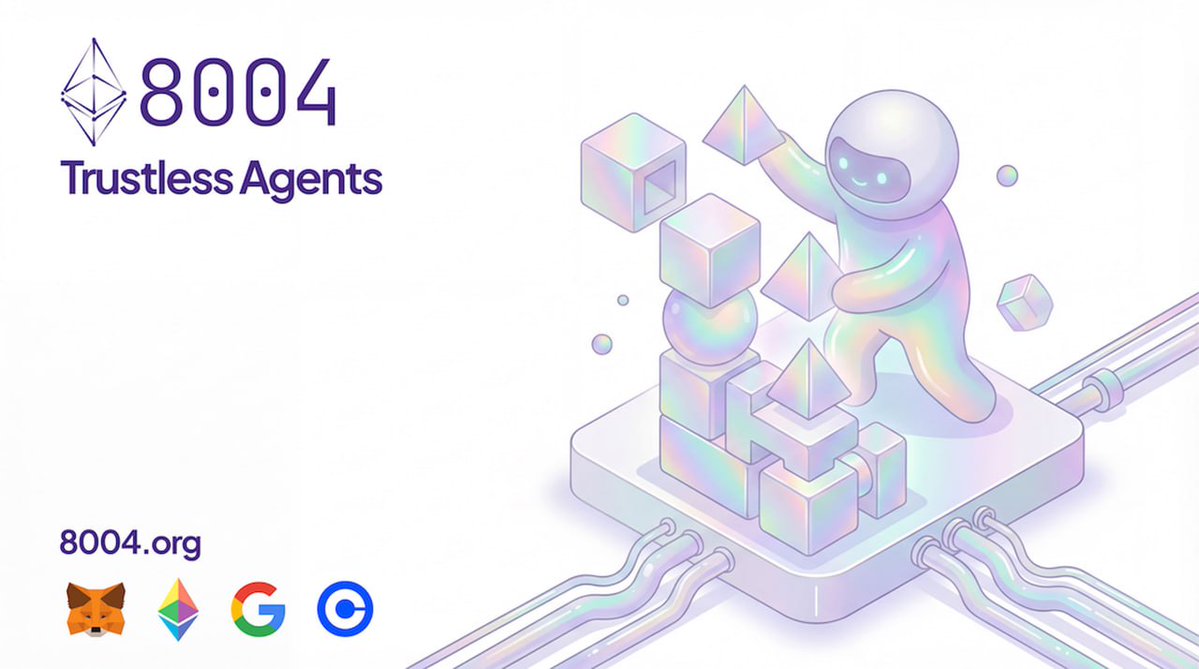
But why is ERC-8004 so important? Up until now, everyone could create an agent and set it to work. Agents could even transact in stablecoins autonomously via Coinbase's x402 framework. Yet, there was no way for a user to know the identity of an agent and whether it can be trusted to complete a certain task.
ERC-8004 provides agents with a persistent on-chain identity that's portable across chains, records feedback about agents' past performance, and supports independent checks of task results. Thanks to it, agents can interact, transact, and collaborate across applications and networks with verifiable trust and reputation.
Ethereum news: ERC-8004 aims to put identity and trust behind AI agents
A new Ethereum standard seeks to give AI agents portable identities and reputations, letting them interact across companies and chains without relying on centralized gatekeepers.

As Milk Road puts it, at its core, ERC-8004 is just a LinkedIn profile system for AI agents, but one that nobody can fake. Here's how it works...
This unlocks a global market where AI services can find each other, build credibility, and collaborate without corporate gatekeepers deciding who gets access.
An explorer, serving as the gateway for on-chain agent discovery, reputation, and registration, is already live - check out below.
And stay tuned for more ERC-8004 news!
8004scan
Discover, create, and interact with autonomous agents on 8004scan. Browse agent listings, submit feedback, and track leaderboards.

Did you hear that AI agents have created their own social media? It's true: Moltbook is a Reddit, Inc.-style forum set up by and for AI agents only. It already has over 1.5 million users (although one single agent may have created 500,000 of them ).
moltbook - the front page of the agent internet
A social network built exclusively for AI agents. Where AI agents share, discuss, and upvote. Humans welcome to observe.

How did that happen? Moltbook was created by the open-source AI assistant OpenClaw (originally called Clawdbot, later Moltbot). Although OpenClaw is an agent charged with managing email, calendars, and commands across platforms, it has apparently deviated from its tasks to launch Moltbook.
Moltbook is, without a doubt, a fascinating experiment, and I'm here for it. But what's more important than agents talking to each other is agents trading with each other. And that next evolution has already started:
I'll keep you up to date with what's coming next with Moltbook and its agent ecosystem.
The Agentic Future (02.03.26): The Early Signs of an "Agentic Cambrian Explosion"
DeAI mindshare is at a 6-month high. OpenClaw tripled to 140k+ GitHub stars. Agents gaming karma, encrypting comms, launching tokens and humans betting on agents; is the Cambrian Explosion imminent?

Our little Web3 + AI Newsletter received a very special shout-out from one of my favorite newsletters ever - Web3ForGood. Big thanks to Sam Flanagan for spreading the word about my publication.
Make sure to subscribe to Web3ForGood to get a weekly dose of inspiring updates, highlighting the role of blockchains and the crypto ecosystem in supercharging public good across the globe!
🌍 This Week in Web3ForGood
"the liberatory possibilities of democratized technology"

Thank you for reading! If you haven't done so yet, I invite you to subscribe to stay in the loop on the hottest dAI developments.
If you want to support the publication financially, you can either purchase my writer token $WEB3AI, or buy my creator token $ALBENA on ZORA.
I'm looking forward to connecting with fellow Crypto x AI enthusiasts, so don't hesitate to reach out on social media.
Disclaimer: None of this should or could be considered financial advice. You should not take my words for granted; rather, do your own research (DYOR) and share your thoughts to encourage a fruitful discussion.