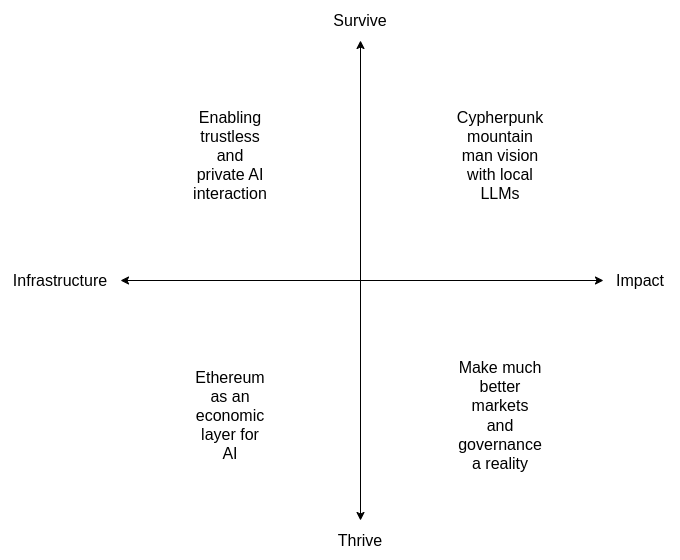
This week, Ethereum's Vitalik Buterin published an update of his 2024 Crypto x AI thesis, accompanied by a strong message to the crypto community, a message that resonates strongly with me. Rather than racing to build the ephemeral AGI, Vitalik says, the goal should be guiding AI development in a way that protects human freedom, spreads power more evenly, and avoids both extreme AI risks and everyday security failures.
When I began writing this newsletter over two years ago, I wanted to unpack what AGI actually meant. OpenAI's Sam Altman, Google's Mustafa Suleyman, and a bunch of other AI executives were going on and on about AGI being just around the corner. Meanwhile, leading researchers and scientists couldn’t even agree on a clear definition of AGI. They still don’t.
I eventually abandoned that idea because I assumed that once those predictions failed to materialize, people would stop buying into the hyperbole. I was wrong. What's more, I failed to recognize that hype and hyperbole serve a purpose. They captivate the public so effectively that we lose sight of who actually controls AI, and who stands to benefit from it.
Fortunately, Vitalik once again appears as the level-headed voice that reaffirms crypto's vision of democratizing access, enforcing privacy, and distributing wealth.
I want an AI future where we foster human freedom and empowerment.
To achieve that, and to position Ethereum as the home of the emerging Agentic economy, Buterin outlines several short-term tasks:
Building tooling to make more trustless and/or private interaction with AIs possible.
Establishing Ethereum as an economic layer for AI-related interactions.
Making the cypherpunk "mountain man" vision ((don't trust; verify everything) a reality.
Making much better markets and governance a reality.
In one of its latest blog posts, the a16z crypto team argues that as AI systems scale, they are outpacing the trust and identity frameworks on which the current internet, designed for human interaction at a much smaller scale, relies. This creates challenges in authenticity, privacy, and payments that traditional internet infrastructure can’t solve on its own.
The problem isn’t that AI exists — it’s that the internet does not have a native way to separate humans from machines while preserving privacy and usability. This is where blockchains come in.
The article lists several verticals where blockchains can help or contribute to a fairer, faster, and more private AI, including:
Raising the costs of AI deepfakes and impersonation through decentralized Proof-of-Personhood solutions;
Ensuring that agents' identities are portable and universal, while carrying references to capabilities, permissions, and payment endpoints across chats, emails, browsers, and APIs;
Catering to AI agents' needs of micropayments, by enabling near-zero-cost transactions and more finely-grained payment splits;
Enforcing privacy and security.
Building on the use cases highlighted by a16z crypto, and circling back to Vitalik's thesis I cited in the beginning, researcher and content creator Stacy Muur offered another point of view on why AI agents don't need more intelligence, but need crypto.
Muur confirms the importance of Web3 decentralized identity and micropayment solutions, but also emphasizes blockchains' role as the coordination layer in multi-agent systems:
Different models operate in different formats, which makes coordination difficult without a shared language or control layer. When one AI comes up with an idea, another AI improves it, and a third AI checks it, it's hard to figure out who gets credit, who gets paid, and who is responsible.
This is where crypto and blockchain naturally fit in, not as intelligence but as infrastructure by recording who did what, when it happened, and how much each contributor added. Through verifiable logs, hashes, attestations, and automated incentives, crypto can act as the accounting and coordination layer that allows diverse AI systems to collaborate.
Muur outlines the must-watch projects pushing the Crypto x AI intersection forward, including Covalent, Questflow, Sentient Labs, Billions Network, cheqd, Vouched, Catena Labs, and more.
In an op-ed for CoinDesk, Altius Labs's Annabelle Huang argues that "if autonomous machine-to-machine (M2M) payments are the new electricity, then blockchains must be seen as the new power grid." M2M payments - tiny, continuous financial transactions between devices without human involvement - will be as foundational to the digital economy as electricity was to the industrial age.
Today’s payment systems are episodic and human-mediated, but future connected devices (e.g., sensors, satellites, factories) will need to transact in real time for data, power, services, and logistics. Just as electricity became an ambient, standardized utility enabling mass automation, M2M payments must become seamless and continuous to unlock a true machine economy.
Blockchain technology, with near-instant and low-cost transactions, is seen as the essential infrastructure, or the “power grid,” for these payments. Building neutral, interoperable, and high-performance blockchain rails is critical to allowing autonomous systems to coordinate and innovate without friction.
Thank you for reading! If you haven't done so yet, I invite you to subscribe to stay in the loop on the hottest dAI developments.
If you want to support the publication financially, you can either purchase my writer token $WEB3AI, or buy my creator token $ALBENA on ZORA.
I'm looking forward to connecting with fellow Crypto x AI enthusiasts, so don't hesitate to reach out on social media.
Disclaimer: None of this should or could be considered financial advice. You should not take my words for granted; rather, do your own research (DYOR) and share your thoughts to encourage a fruitful discussion.

This week, Ethereum's Vitalik Buterin published an update of his 2024 Crypto x AI thesis, accompanied by a strong message to the crypto community, a message that resonates strongly with me. Rather than racing to build the ephemeral AGI, Vitalik says, the goal should be guiding AI development in a way that protects human freedom, spreads power more evenly, and avoids both extreme AI risks and everyday security failures.
When I began writing this newsletter over two years ago, I wanted to unpack what AGI actually meant. OpenAI's Sam Altman, Google's Mustafa Suleyman, and a bunch of other AI executives were going on and on about AGI being just around the corner. Meanwhile, leading researchers and scientists couldn’t even agree on a clear definition of AGI. They still don’t.
I eventually abandoned that idea because I assumed that once those predictions failed to materialize, people would stop buying into the hyperbole. I was wrong. What's more, I failed to recognize that hype and hyperbole serve a purpose. They captivate the public so effectively that we lose sight of who actually controls AI, and who stands to benefit from it.
Fortunately, Vitalik once again appears as the level-headed voice that reaffirms crypto's vision of democratizing access, enforcing privacy, and distributing wealth.
I want an AI future where we foster human freedom and empowerment.
To achieve that, and to position Ethereum as the home of the emerging Agentic economy, Buterin outlines several short-term tasks:
Building tooling to make more trustless and/or private interaction with AIs possible.
Establishing Ethereum as an economic layer for AI-related interactions.
Making the cypherpunk "mountain man" vision ((don't trust; verify everything) a reality.
Making much better markets and governance a reality.
In one of its latest blog posts, the a16z crypto team argues that as AI systems scale, they are outpacing the trust and identity frameworks on which the current internet, designed for human interaction at a much smaller scale, relies. This creates challenges in authenticity, privacy, and payments that traditional internet infrastructure can’t solve on its own.
The problem isn’t that AI exists — it’s that the internet does not have a native way to separate humans from machines while preserving privacy and usability. This is where blockchains come in.
The article lists several verticals where blockchains can help or contribute to a fairer, faster, and more private AI, including:
Raising the costs of AI deepfakes and impersonation through decentralized Proof-of-Personhood solutions;
Ensuring that agents' identities are portable and universal, while carrying references to capabilities, permissions, and payment endpoints across chats, emails, browsers, and APIs;
Catering to AI agents' needs of micropayments, by enabling near-zero-cost transactions and more finely-grained payment splits;
Enforcing privacy and security.
Building on the use cases highlighted by a16z crypto, and circling back to Vitalik's thesis I cited in the beginning, researcher and content creator Stacy Muur offered another point of view on why AI agents don't need more intelligence, but need crypto.
Muur confirms the importance of Web3 decentralized identity and micropayment solutions, but also emphasizes blockchains' role as the coordination layer in multi-agent systems:
Different models operate in different formats, which makes coordination difficult without a shared language or control layer. When one AI comes up with an idea, another AI improves it, and a third AI checks it, it's hard to figure out who gets credit, who gets paid, and who is responsible.
This is where crypto and blockchain naturally fit in, not as intelligence but as infrastructure by recording who did what, when it happened, and how much each contributor added. Through verifiable logs, hashes, attestations, and automated incentives, crypto can act as the accounting and coordination layer that allows diverse AI systems to collaborate.
Muur outlines the must-watch projects pushing the Crypto x AI intersection forward, including Covalent, Questflow, Sentient Labs, Billions Network, cheqd, Vouched, Catena Labs, and more.
In an op-ed for CoinDesk, Altius Labs's Annabelle Huang argues that "if autonomous machine-to-machine (M2M) payments are the new electricity, then blockchains must be seen as the new power grid." M2M payments - tiny, continuous financial transactions between devices without human involvement - will be as foundational to the digital economy as electricity was to the industrial age.
Today’s payment systems are episodic and human-mediated, but future connected devices (e.g., sensors, satellites, factories) will need to transact in real time for data, power, services, and logistics. Just as electricity became an ambient, standardized utility enabling mass automation, M2M payments must become seamless and continuous to unlock a true machine economy.
Blockchain technology, with near-instant and low-cost transactions, is seen as the essential infrastructure, or the “power grid,” for these payments. Building neutral, interoperable, and high-performance blockchain rails is critical to allowing autonomous systems to coordinate and innovate without friction.
Thank you for reading! If you haven't done so yet, I invite you to subscribe to stay in the loop on the hottest dAI developments.
If you want to support the publication financially, you can either purchase my writer token $WEB3AI, or buy my creator token $ALBENA on ZORA.
I'm looking forward to connecting with fellow Crypto x AI enthusiasts, so don't hesitate to reach out on social media.
Disclaimer: None of this should or could be considered financial advice. You should not take my words for granted; rather, do your own research (DYOR) and share your thoughts to encourage a fruitful discussion.

Web3 + AI + Privacy: Spotlight on Ethereum
With its current focus on privacy, the crypto world returns to its cypherpunk roots. But how would it affect Web3 + AI?

The Web3 + AI Daily #35
Your definitive guide to the world of Decentralized AI (DeAI/dAI).

The Web3 + AI Daily #51
Daily insights into the fascinating convergence of Crypto and AI.

Web3 + AI + Privacy: Spotlight on Ethereum
With its current focus on privacy, the crypto world returns to its cypherpunk roots. But how would it affect Web3 + AI?

The Web3 + AI Daily #35
Your definitive guide to the world of Decentralized AI (DeAI/dAI).

The Web3 + AI Daily #51
Daily insights into the fascinating convergence of Crypto and AI.
>100 subscribers
>100 subscribers
Share Dialog
Share Dialog
No comments yet