

Hello, everyone, and welcome to all newly joined subscribers!
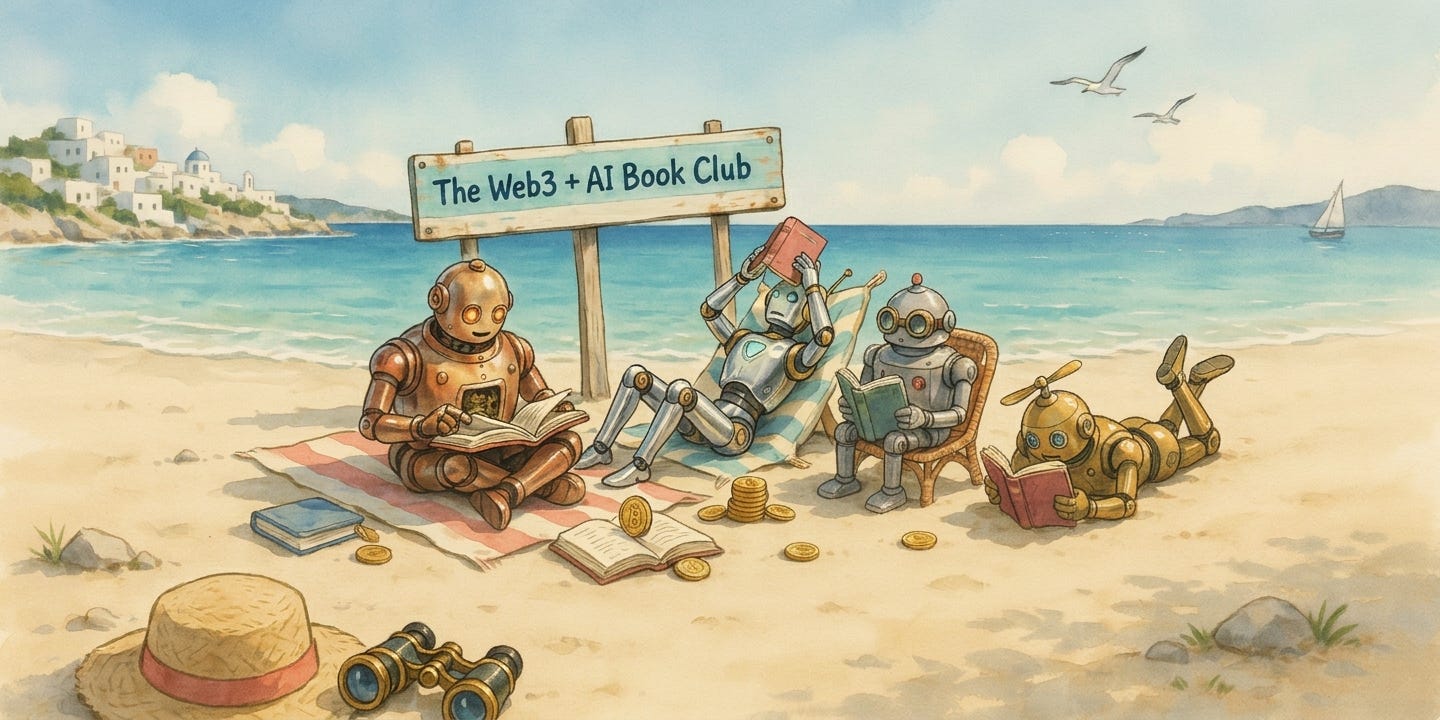
The Web3 + AI Book Club examines AI, Web3, and other emerging technologies’ profound impact on society, democracy, and the way we live, through books. Join our shared literary space on Fable to read and discuss the hottest titles with us.
So far, we’ve explored Mustafa Suleyman and Michael Bhaskar‘s ‘The Coming Wave: AI, Power, and the 21st Century’s Greatest Dilemma’, Jeff Sebo‘s ‘The Moral Circle: Who Matters, What Matters, and Why’, and Laura Bates‘ ‘The New Age of Sexism’.
Today, I’m reviewing ‘The AI Con: How to Fight Big Tech’s Hype and Create the Future We Want’ by Emily M. Bender and Alex Hanna, Ph.D..
Thank you for being here! Let’s dive in.
‘The AI Con’
As the authors have stated themselves, this book unveils the worst of the AI hype and “pops it with the sharpest needle” possible, in the hope of helping you spot the hype now and the next time around a tech bubble arises.
‘The AI Con’ breaks down the different ways in which AI disrupts industries, social systems, science, and creativity, and why the end-result is rarely positive. It analyzes how the very existence of robotaxies devalues the work of human taxi drivers, how automation tools hinder predominantly marginalized communities and enhance the systemic racism, and why using chatbots as legal assistants and representatives in court is a very bad idea. It also emphasizes that, when it comes to providing social services and care, humans cannot and should not be replaced.
“The rush to replace all government services across healthcare, education, and law with AI is inspired and funded by Silicon Valley, tech executives and their philanthropic arms.”
The Essential Role of Hype
In fact, the book highlights many of the AI-related challenges on which I have repeatedly shed light in this blog. Examples spread across the financial and environmental cost of producing AI, the dramatic effects the current AI craze has on creative professions, the dangers of anthropomorphizing AI, and the questionable motives behind fighting for “AI Safety.”
“AI is a con. A few well-funded companies accumulating significant wealth by extracting value from other people’s creative work, personal data, or labor.”
Most importantly, it reiterates what I have been saying for years: the hype is not accidental. It is designed.
The hype is created, even encouraged, because it is only hype that can channel such an enormous financial resource toward an industry that hasn’t even achieved a true product-market-fit yet.
“Without the promise of replacing workers, these AI labs couldn’t sustain their billion- (even trillion-) dollar valuations.
How else would you explain that both OpenAI and Anthropic are currently eyeing $1 trillion+ IPOs while continuing to operate at multi-billion-dollar annual losses? As the saying goes, don’t believe the hype.
The Doom is Upon Us
The prevalent doomerism vis-à-vis AI is an important topic for me - the very first title in our book club - Mustafa Suleyman’s ‘The Coming Wave’ - can only be characterized as a doomer propaganda. After reading it, I have often pointed out the ridiculousness of doomer claims made by Big Tech founders like Sam Altman and Elon Musk, and ‘The AI Con’ does so, too.
“The language of p-doom (probability of doom) aims to keep us focused on imaginary, catastrophic scenarios resulting from this allegedly world-ending technology, while distracting us from the daily harms done in its name. This type of con is the AI hype.”
It would have been quite funny watching these so-called tech leaders explain in such seriousness how an AI superintelligence is coming to kill us all, if their statements hadn’t influenced global politics, economics, and societies.
“P-doom sounds like an important metric, but it is actually meant to grab headlines and remind of children’s books’ battle of good vs. evil. It helps Big Tech founders present themselves as superheroes saving the humanity, whereas in the meantime, they turn their backs on actual dangers.”
Actually, the whole discourse around AI over the last 3-4 years is an example of how easily malleable and manipulated the public is. While Big Tech has been scaring us with the impending doom, these same tech gurus have been persuading us of the inevitability, and eventually benefit, of AGI (Artificial General Intelligence). We should have guessed that the “doomers” and the “boosters” are one and the same.
Doomers vs. Boosters
I loved the part of the book where Bender and Hanna describe boosters and doomers as the two sides of the same coin:
“The substance of the coin is the belief that the development of AI is inevitable, and that that resulting technology will be both autonomous and powerful, and ultimately beneficial, if we play our cards right. It’s only the faces of the coin that differ. One shows a utopian world of abundance, the other - a dystopian hellscape. Neither depicts the real harms of actually existing automation, at best dismissing them as less important than the imaginary existential threats. Should you be scared of an autonomous AI agent? No. But you should be wary of the alarming ideologies behind both AI doomerism and boosterism.”
The authors also make the connection between this pretend ideological confrontation and the emergence of the discipline “AI Safety,” which they characterize as the “doomer / booster research field.”
“Despite the name, this work does not come out of systems safety engineering, which is a real field, with first principles, requirements, and engineering specifications. But instead from a truncated and misunderstood application of those ideas.”
The regular readers of this blog are aware of how often I’m asking the questions: “What is AI Safety?” and “Why do AI labs allegedly invest millions to achieve something that isn’t even clearly defined?” As it turns out, the ambivalence about the field of AI Safety was the desired effect.
“AI Safety is concerned with the fantasy of a runaway AI system resulting in a mass casualty event. There is no reason to believe any such event is remotely likely to occur, but that hasn’t prevented the proliferation of research centers with names like the Center for AI Safety at the University of California, Berkeley, and the Center for the Study of Existential Risk at the University of Cambridge, all generously funded by wealthy AI doomers.”
Bender and Hanna also cite the work of computer scientist Timnit Gebru and philosopher Émile P. Torres, and the the acronym they coined to depict the myriad ideologies and movements Big Tech relies on to justify its actions:
“TESCREAL stands for: transhumanism, extropianism, singularterrianism, cosmism, rationalism, effective altruism, and longtermism. While all of these have their own tenants, they have overlapping sets of adherence and can be summed up in a few words. Those in the TESC part of the acronym, maintain that humans are at some point going to merge with machines and fly off Earth to colonize space. The REAL part of the acronym concerns an ultrautalitarian ethic that holds that we as humans need to optimize our behavior to do the most good with the resources available to us.”
So, the next time you come across Elon Musk demanding for childless people to be stripped of voting rights because “they lack stake in the future,” ask yourselves what his true motives are and whether he truly cares about democracy and the wellbeing of all humans.
“The actually existing human suffering, born primarily in the majority of the world, is ignored for hypothetical threats of rogue algorithms. This is a eugenicist frame of seeing the world. The need of advancement for future white people at the cost of the black and brown people at the here and now.”
My Honest Take
I generally enjoyed ‘The AI Con,’ and I think it is an important book for everyone to read, especially now when, whether we like it or not, AI is increasingly becoming a big part of our lives. However, I must say, I disagree with some of the theses expressed by the authors, and I’ll tell you why.
First, Bender and Hanna are of the opinion that the creation of automation technologies, in general, is not socially desirable, and I must oppose that stance. Yes, automation could, in some cases, have serious socio-economic consequences, but there are also multiple scenarios where it could improve productivity and prevent errors. Automation is not a panacea and should not be introduced across the board without considering the risks. Yet, that doesn’t mean that it is without any merits. Let’s not forget that the Nobel Prize-winning AlphaFold project by Google DeepMind successfully automated one of the most difficult tasks in biology: predicting the three-dimensional structure of proteins from their amino acid sequences.
Second, the entire time I was reading, I felt like the authors use the broad term “AI” to talk predominantly about generative AI and large language models (LLMs), thus failing to distinguish the diverse landscape of AI scientific research. Similarly, Bender and Hanna direct most of their criticism toward AI labs like OpenAI, Anthropic, and Google, and though this is fully deserved, it leaves the reader with the impression that there’s no AI development and innovation beyond those achieved by the hyperscalers.
AI is Here to Stay, Fortunately
My thesis is that the interdisciplinary research field of Artificial Intelligence has existed for over 70 years and will continue to do so after the current bubble has burst. It serves no one to attack the science of AI and condemn it altogether as a ‘con’ when we’re actually mad at Elon Musk, Sam Altman and Marc Andreessen for reigniting the hype to enrich themselves even further. Let’s call things as they are and keep the actual culprits responsible.
While the book suggests that AI is all bad, the reality is way different. The various technologies existing under the broad umbrella term of “AI” can be extremely useful and beneficial, if used adequately and responsibly. For instance, Bulgaria’s INSAIT - Institute for Computer Science, Artificial Intelligence and Technology recently unveiled FireScope AI - the first AI system for predicting wildfire risk across Europe and enabling European countries to immediately and more effectively target wildfire prevention, preparedness, land-use planning, and climate adaptation. And that is just one example of many.
And yes, generative AI and LLMs could harm the very fabric of our societies in many different ways, but they are helping people, too. Maybe we can’t always imagine who and when would have a vital question to ask and prompting a chatbot would be their only option. To echo what Web3forGood and Crypto Altruists are saying, we in the crypto space have lived through extreme hypes over and over again, and are well aware of how overwhelming the noise can be. Yet, throughout all these cycles, we still ended up producing useful technologies.
Our July Book Club Title is Here!
In July, we’re reading Karen Hao’s ‘Empire of AI: Dreams and Nightmares in Sam Altman’s OpenAI’ - a New York Times bestseller and winner of multiple awards for nonfiction. Investigative journalist and AI expert Karen Hao covers the story of OpenAI - from its founding as a non-profit to the global phenomenon it is today, with all the nuances, scandal, and ideological turns that have been accompanying it since 2019.
Check out this brilliant conversation of Karen Hao with Professor Naomi Klein to get you excited about reading ‘Empire of AI’ with us:
Thank you for reading! I hope you found this article insightful.
If you’d like to keep up with the latest developments at the burgeoning intersection of blockchain and AI, I invite you to subscribe.
And if you find value in my writing, consider supporting the newsletter. I’d greatly appreciate it.
The Web3 + AI Book Club is live on Fable. Follow the link below and come join our literary community.
I'm looking forward to connecting with fellow Crypto x AI enthusiasts, so don't hesitate to share your thoughts here or reach out on LinkedIn, Instagram, or Firefly.social.
Disclaimer: The content of this newsletter is provided for informational and educational purposes only. Nothing contained herein should be construed as financial advice or as a recommendation to buy, sell, or hold any of the companies or assets mentioned.
Please don’t take my views at face value. Instead, do your own research (DYOR), think critically, and share your perspective so we can challenge ideas, learn from one another, and arrive at better conclusions through thoughtful discussion.